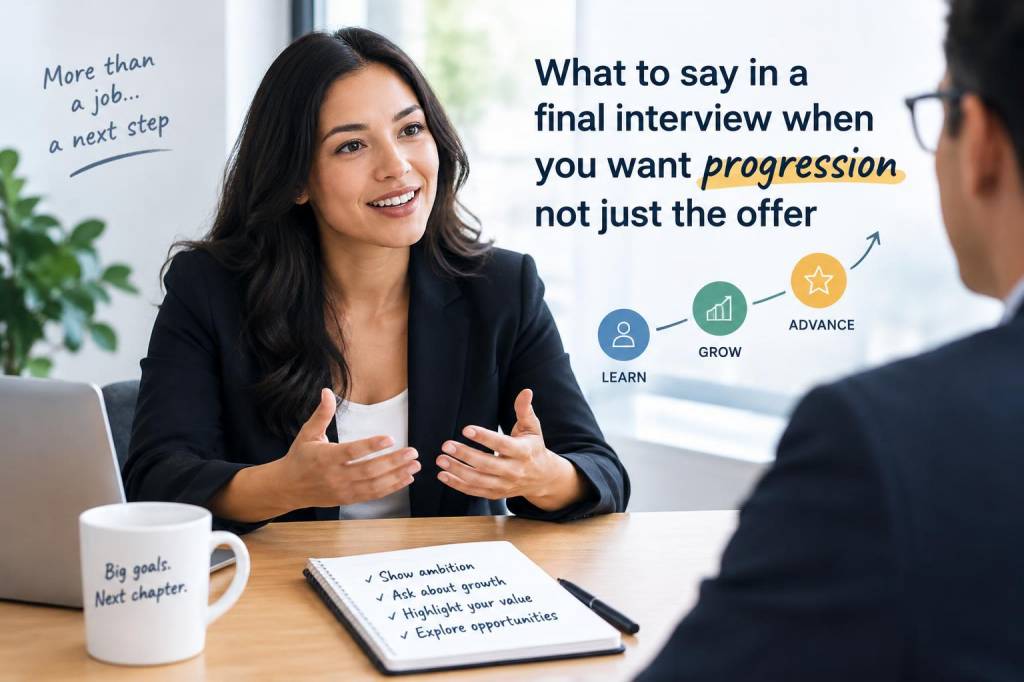
By a final interview, I want to leave no doubt about two things: I can do the job, and I am thinking beyond it. That second point matters more than many candidates realise. If you want progression, not just an offer, I would not wait for the employer to ask about ambition. I would address it with care, clarity, and a calm sense of direction.
In my experience, final interviews are rarely only about technical fit. They are often about long-term fit, team maturity, and whether a person will stay engaged once the initial learning curve ends. When I have coached candidates for these stages, I have seen that the strongest answers are not loud or overly ambitious. They are specific, thoughtful, and connected to the role in front of you.
What I mean by progression
When I say progression, I do not mean walking into an interview and talking as if you already expect a promotion. That can sound presumptuous. I mean showing that you care about development, responsibility, learning, and impact. I want employers to hear that you are not only looking for a salary or a title. I want them to understand that you want a role where you can grow, contribute more over time, and take on increasing ownership.
That distinction changes everything. If you sound as though you are chasing status, people may worry you will get bored quickly. If you sound as though you are looking for challenge, learning, and a realistic route to added responsibility, you come across as someone worth investing in.
What I say when they ask why I want this role
One of the simplest moments to signal progression is when you are asked why you want the job. I would not give a generic answer about liking the company or wanting a new challenge. I would connect the role to a longer view of my development.
I might say something like:
“I am interested in this role because it gives me the chance to make a strong contribution now, while also developing the skills I would need to take on broader responsibility over time. What appeals to me is that the work is practical, visible, and linked to real outcomes, so I can build depth and grow in a meaningful way.”
That kind of answer shows ambition without sounding demanding. It tells the panel that I am not just collecting job titles. I am thinking about performance, learning, and value.
What I say when they ask where I see myself in a few years
This question is a direct invitation to talk about progression, and I would never waste it with a vague answer. I would avoid saying I see myself “doing well” or “still being with the company.” Those answers are safe, but forgettable.
I prefer an answer that shows direction without pretending I can predict an exact path. For example:
“In a few years, I would hope to have built a strong track record in this area, taken on more complex work, and become someone the team can rely on for both delivery and judgement. I would also like to keep developing my leadership and problem-solving skills so I can contribute at a higher level as the business evolves.”
That answer is useful because it is stable, mature, and employer-focused. It says I am interested in growth, but not in racing ahead without earning it.
What I say when I want to ask about development
Many candidates are nervous about asking about progression in a final interview because they fear sounding entitled. I understand that concern, but I still think it is important to ask. The key is to frame the question around development, not entitlement.
I would ask something like:
- “What does progression usually look like for someone who performs well in this role?”
- “How do you support people who want to take on greater responsibility over time?”
- “What skills or behaviours tend to open up future opportunities here?”
- “How would success in this role be recognised over the first twelve to eighteen months?”
These questions work because they signal seriousness. I am showing that I want to understand the path ahead, but I am also asking about performance, expectations, and contribution. That makes me look invested rather than impatient.
What I avoid saying
There are some phrases I would not use, even if I mean well. In final interviews, language matters. If I say the wrong thing, I can make myself sound restless, unrealistic, or too focused on myself.
| Avoid saying | Why it can backfire | Stronger version |
| “I want to move up quickly.” | Can sound impatient or entitled. | “I want to keep developing and earn greater responsibility over time.” |
| “What is the fastest route to promotion?” | May sound like the current role is only a stepping stone. | “What does strong performance look like here, and how is growth recognised?” |
| “I am hoping this role leads to something bigger.” | Too vague and a little self-centred. | “I am looking for a role where I can contribute now and grow into wider responsibility.” |
| “I do not want to be doing this forever.” | Signals disengagement from the actual job. | “I am looking for a position with room to build capability and expand impact.” |
I have seen candidates lose momentum because they accidentally made the role sound too small for them. A final interview is not the place to dismiss the present in favour of the future. I want both to sound important.
What I say to show ambition without arrogance
The balance I aim for is simple: confidence with humility. I want to communicate that I am ambitious, but also grounded. That means I speak in terms of contribution first, ambition second.
For example, I might say:
“I am motivated by roles where I can solve real problems, learn fast, and gradually become more useful to the business. I am not looking for shortcuts. I want to prove myself, deliver well, and grow from there.”
That kind of phrasing reassures the interviewer. It shows that my focus is not on self-advancement alone. It is on earned development.
What I say if I want a leadership path later
Some candidates want progression into management, but they worry about saying that too early. I think it is fine to mention leadership if it is relevant, as long as I keep it realistic and linked to the role.
I might say:
“Long term, I would like to develop into a position where I can take on more coordination, help shape process, and support others as well as delivering on my own work. For me, leadership is about becoming more useful to the team in a wider sense.”
That answer works because it avoids power language. It does not sound like I am desperate for authority. It sounds like I care about influence, reliability, and service to the team.
How I read the room before I raise progression
I never rush into a career-growth conversation without reading the tone of the interview first. If the panel is focused on urgent delivery, I keep my progression comments brief and practical. If they start talking about future plans, team expansion, or talent development, I lean further into that discussion.
I look for clues in the way they speak. Do they mention succession planning? Do they talk about internal mobility? Do they describe people who have grown in the team? If so, I know they are open to this conversation. If not, I still raise it, but I keep it subtle and grounded in performance.
What matters most is that I do not force the issue. A final interview should feel like a professional exchange, not a pitch for a future promotion that has not been earned.
What I say when I want to sound ready for more
Sometimes I want to make one final point before the interview ends: I am ready for challenge. In those moments, I keep it simple.
I might say:
“What excites me about this opportunity is the chance to do strong work now and build toward greater impact in the future. I like roles that stretch me, and I tend to do my best work when I can see a path for continued growth.”
That sentence does a lot of work. It shows motivation, self-awareness, and maturity. It tells the interviewer that I am not afraid of hard work, and that I want a place where development is part of the culture.
What I want employers to hear between my words
When I speak about progression in a final interview, I want the employer to hear five things clearly: I am committed, I am coachable, I am ambitious, I am realistic, and I am thinking about the business as well as my own career. Those signals matter because they reduce risk. A hiring team is not only choosing someone who can do the work now. They are choosing someone they can trust to grow into more.
I have always found that the strongest candidates do not try to impress with grand statements. They sound precise. They know what they want, but they say it in a way that fits the stage of the process. They leave room for the employer to imagine a future with them, not just a current vacancy filled.
That is why I pay close attention to every sentence in a final interview. The right words can show that I am ready for the offer, but also ready for what comes after it: learning, stretch, responsibility, and a career that keeps moving forward.