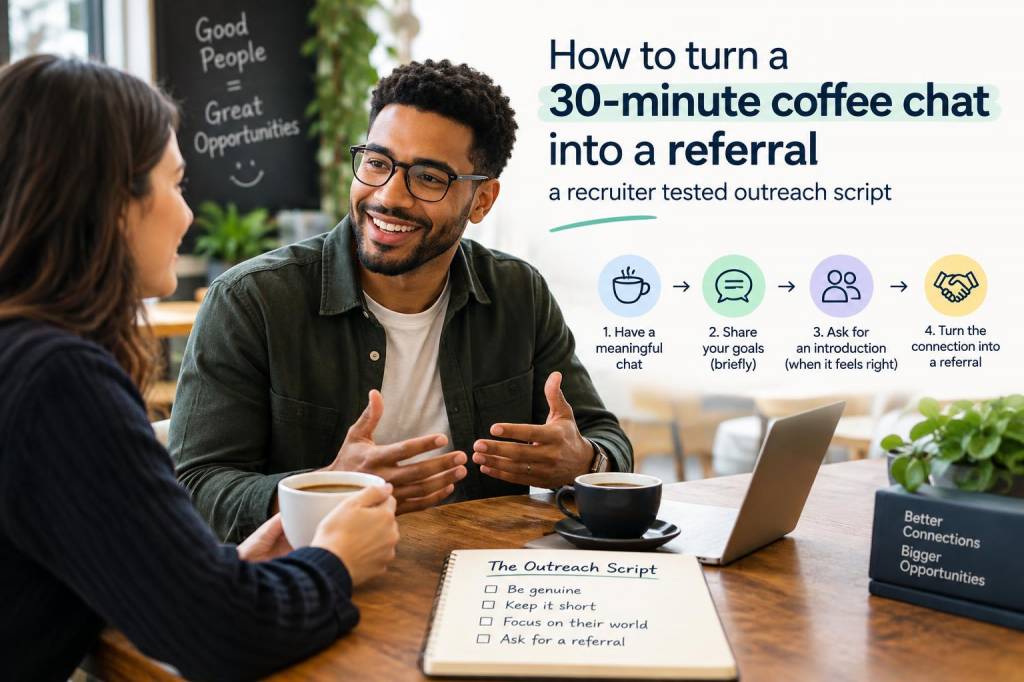
I’ve sat on both sides of the hiring table enough times to know that the quickest route to a warm introduction isn’t a cold CV dropped into an applicant‑tracking system — it’s a short, thoughtful conversation that turns into a referral. Coffee chats are the low‑pressure bridge between curiosity and opportunity. Here’s how I turn a 30‑minute coffee chat into a referral, with recruiter‑tested scripts you can adapt and the exact phrases that work.
Why a 30‑minute coffee chat works
A coffee chat is not an interview. It’s a chance to build rapport, learn about the team and role context, and show you understand the employer’s priorities. From a recruiter’s perspective, a candidate who demonstrates cultural fit and role relevance in a quick chat is far easier to recommend to hiring managers than someone who only fits on paper.
My advice is practical: prepare a short clear agenda, ask targeted questions, share a two‑minute narrative about your background, and finish with a specific, low‑friction referral ask. The last minute is where many people fail — they leave without converting rapport into next steps.
Before the chat: do the prep work
- Research the person and the company — skim their LinkedIn, recent press or blog posts, and the team page. Note one or two genuine points of connection.
- Clarify your objective — do you want information about a team, an introduction to a hiring manager, or feedback on your CV? Pick a primary goal and a backup.
- Prepare your 2‑minute story — a concise summary of who you are, what you do, and what you’re looking for. Keep it role‑focused, not a life story.
- Set an agenda — tell them you'll take 30 minutes and outline the topics: quick intro, their experience, role/team questions, and one closing question (referral or next step).
The recruiter‑tested outreach script (LinkedIn message)
Use this when you’re asking for the coffee chat. Keep it under 200 words and personalise one sentence.
Hi [Name], I’m [Your Name], a [job title/graduate in X] exploring roles in [team/sector]. I enjoyed your piece/comment about [specific detail] and would value a 20–30 minute chat to learn about how your team works and whether my background in [skill/sector] could be a fit. Are you available for a quick coffee chat next week? Thanks — [Your Name]
This feels human, concise and shows you've done some homework. If they’re internal to a company you want, ask for an "informal coffee" rather than "advice" — the former sounds like a peer conversation.
Opening the chat: set the tone and agenda
Start with a quick thank you and set expectations.
Thanks for making time. I’ve got 30 minutes — I’d love to hear about your role and team (10 mins), share a quick overview of my background (5 mins), and ask a couple of practical questions about hiring and team priorities (15 mins). Sound good?
That small framing keeps the conversation brisk and shows respect for their time.
Ask the right questions (the ones that lead to referrals)
- About priorities: "What are the top priorities for your team this quarter?" — reveals problems they need solving.
- About success: "What does success look like for someone in this role after 6 months?" — helps you align your examples.
- About gaps: "Are there skills or experiences you wish candidates had more often?" — gives you an opportunity to explain how you meet those gaps.
- About hiring process: "How do candidates usually progress here? Any tips to make an application stand out?" — practical intelligence you can action immediately.
Your 2‑minute pitch — what to say and what to avoid
Keep it structured: present, recent achievements, and what you’re seeking. Example:
I'm a marketing specialist with three years in B2B SaaS. Recently I led a campaign that increased demo sign‑ups by 40% in six months, focusing on content and paid channels. I'm now targeting senior marketing roles where I can blend demand gen and content strategy — ideally on a product with a strong data culture. I’m interested in how your team balances growth and product marketing.
Avoid rambling about every job you’ve had. Stick to the two or three points that make you relevant to the role or team you want.
Turning rapport into a referral: the closing script
When you’ve established fit, move to a specific, actionable ask. Here are recruiter‑tested closing lines I use and recommend:
- Direct and low friction: "If you think there’s a fit, would you be comfortable introducing me to the hiring manager or dropping my CV to the team? I can send a short note and my CV if that's helpful."
- Permission‑based: "Would it be alright if I applied formally? If so, would you mind flagging my application internally?"
- Offer value: "If it helps, I can send a one‑page summary that maps my experience to the role’s priorities you mentioned."
These options give them control and reduce the awkwardness of asking for help. Most people prefer to agree to a small, concrete action (sending an email, forwarding a CV) than to make a vague promise.
Follow‑up: scripts and timing
Always follow up within 24 hours with a brief thank you and a reminder of any next steps. Use this script:
Hi [Name], thanks again for your time today — I really enjoyed hearing about [specific detail]. I’m sending my CV and a one‑page note mapping how my experience links to [priority] as discussed. If you’re able to share this with the team or the hiring manager, I’d hugely appreciate it. Best, [Your Name]
If they agreed to an intro and you don’t hear back in a week, send one polite nudge offering to make it easy:
Hi [Name], just checking in — happy to draft a short intro you can forward if that’s easier. No pressure either way, and thanks again for offering to help.
Common pitfalls and how to avoid them
- Asking for a job outright: A coffee chat that starts with "Can you get me a job?" rarely ends well. Build rapport first.
- Being vague about next steps: Always end the chat with a clear, specific action you’d like them to take.
- Overloading with documents: Offer your CV and a one‑page summary. Don’t send an entire portfolio unless requested.
- Ignoring the referee relationship: If they refer you, follow up to say thank you and update them on the process — it’s how you build long‑term allies.
A quick tracker to use after chats
| Contact | Date | Primary takeaway | Next step | Status |
| [Name] | [Date] | [Top priority or insight] | [Intro requested / CV sent] | [Pending / Done] |
Use a simple table like this in Google Sheets or Notion to keep momentum. Treat each coffee chat as part of a network strategy, not a one‑off hope.
If you want, I can share a downloadable one‑page template that maps your experience to role priorities — it’s the single most useful follow‑up item I coach candidates to use. Say the word and I’ll draft it into a clean, recruiter‑friendly format you can reuse.