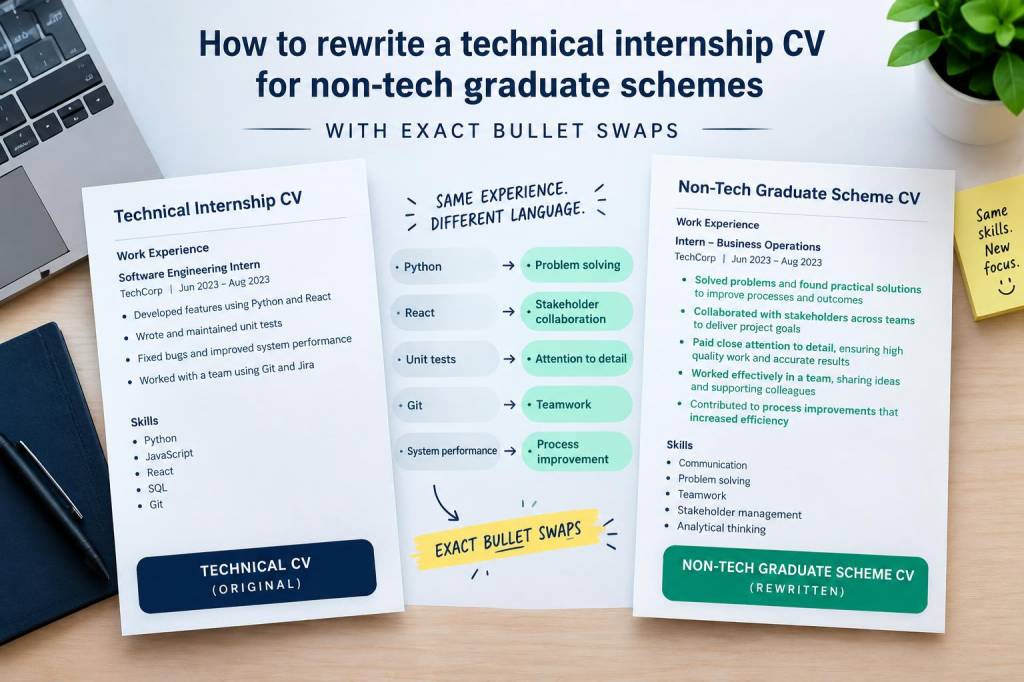
I often see talented graduates who worked in technical internships struggle to translate that experience for non‑tech graduate schemes. The challenge isn’t that your internship doesn’t matter — it’s that hiring teams in finance, consulting, HR or marketing are looking for different signals. Below I share a practical, repeatable method for rewriting technical internship CV bullets, plus exact bullet swaps you can paste into your CV and adapt. These swaps highlight transferable impact, business context and the competencies non‑technical recruiters value.
Why you should rewrite, not invent
It’s tempting to pare down a technical CV to the bare bones, but removing detail loses evidence of competence. Instead, focus on reframing: keep the truth, but change the emphasis. Recruiters for non‑tech roles want to see problem solving, stakeholder communication, data‑driven decision making, project ownership and commercial awareness. Those are all things you did in a technical internship — you just need to make them explicit.
My three‑step reframing method
Use this simple framework for every bullet: Context → Action → Outcome, then translate the language into the recruiter’s vocabulary.
After writing the new bullet, check it against the job advert and add one or two keywords from the role (e.g., "vendor management", "cost savings", "process improvement").
Exact bullet swaps: from technical internship to non‑tech graduate scheme language
Below are side‑by‑side swaps you can use. Keep one or two original technical details if they help credibility (e.g., "SQL" or "Python" only when relevant to the role), but prioritise business outcomes.
| Original technical bullet | Swapped bullet for non‑tech schemes |
|---|---|
| Built ETL pipeline in Python to aggregate sales data from three sources. | Consolidated sales data from three sources to create a single dataset used by the commercial team, reducing data preparation time by ~40% and enabling faster weekly reporting. |
| Optimised database queries, improving runtime by 60%. | Improved performance of internal reports by optimising data retrieval, cutting report generation time by 60% and freeing up analysts to complete deeper analysis. |
| Developed a machine learning model to predict customer churn (AUC 0.82). | Designed a predictive model to identify customers at high risk of churn; results informed a targeted retention campaign projected to increase retention by 8% among at‑risk segments. |
| Implemented CI/CD pipeline using Jenkins and Docker. | Introduced automation to the deployment process, reducing manual steps and lowering the risk of release delays — improved deployment reliability for cross‑team projects. |
| Wrote unit tests increasing code coverage to 85%. | Established testing standards to improve product reliability, reducing post‑release defects and supporting smoother handovers to the support team. |
| Debugged application errors in production under time pressure. | Resolved urgent production issues to restore service availability, coordinating with cross‑functional teams to communicate status and minimise customer impact. |
| Worked with REST APIs to integrate third‑party data. | Integrated third‑party data sources to enrich internal datasets, enabling the insights team to broaden analytical coverage and support better commercial decisions. |
| Created dashboards in Tableau to visualise user engagement. | Developed dashboards to visualise user engagement trends and presented findings to product and marketing stakeholders to inform roadmap priorities. |
| Refactored legacy codebase to follow modern patterns. | Led improvements to an ageing system to simplify maintenance, reducing time spent on routine fixes and enabling the team to deliver two new features faster. |
| Collaborated with DevOps to deploy microservices. | Collaborated with operations to launch modular services, improving release flexibility and shortening the time from development to customer availability. |
Examples tailored to specific non‑tech schemes
Different sectors value different phrasing. Use these variants to tune bullets to the scheme you’re applying for.
Consulting & Strategy
Finance & Risk
Marketing & Commercial
HR & People
Quick editing checklist (copy into your CV review)
How I test the changes before applying
I recommend two light tests that take ten minutes each:
When to keep technical details
Include specific tools or metrics when they strengthen credibility or match the job spec. For example, if the programme values data literacy, a line like "used SQL and Excel to extract and model datasets for monthly forecasting" shows capability without overwhelming non‑technical readers.
Final practical tip — a reusable template
Use this template to rework each technical bullet quickly:
Example: "Commercial analytics team — consolidated cross‑channel sales data for weekly reporting — reduced prep time by 40% and improved insight turnaround for the sales director."
If you’d like, send two of your original technical bullets and I’ll rewrite them in the style above with role‑specific tweaks you can paste straight into your CV for Jobzvice Co (jobzvice.co.uk) applications.