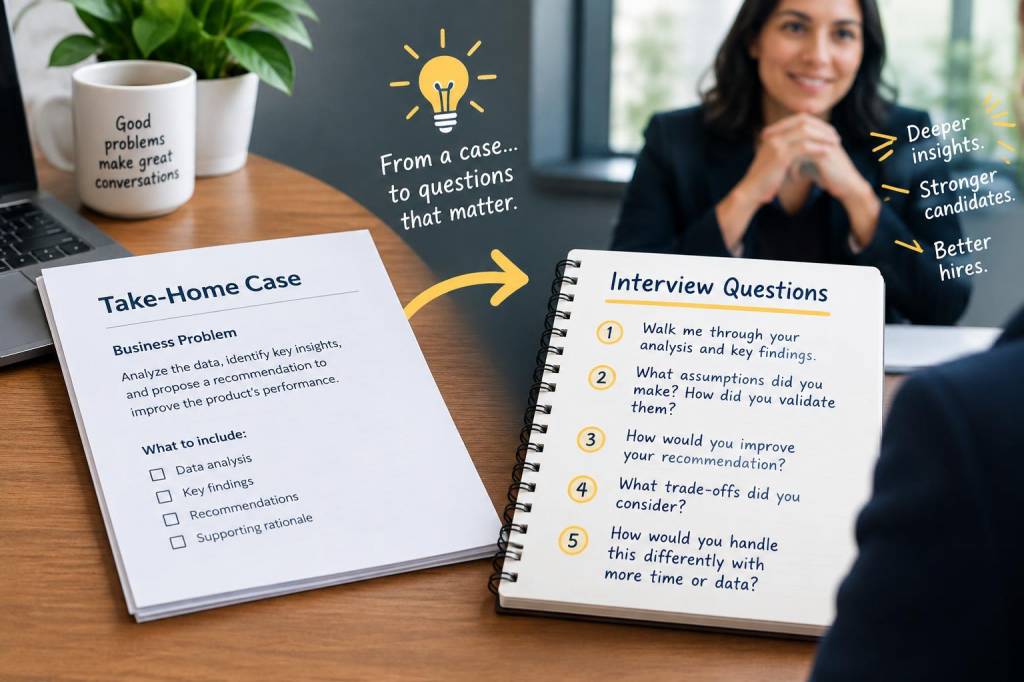
You’ve just submitted a take‑home case. Maybe you handed in a polished slide deck, a short prototype, or a written recommendation. You did the work — but the hiring process isn’t over. Converting your case into interview questions that hiring managers can’t ignore is one of the highest‑leverage things you can do next. Done well, it turns a static deliverable into a compelling story that showcases your thinking, impact and fit.
Why treating your take‑home case like an interview asset matters
Hiring managers receive lots of take‑home exercises. The ones that stand out are those that go beyond “here’s the deliverable” and instead lead the interviewer through the decisions, trade‑offs and behaviours the candidate demonstrated. I approach every case as a narrative: it’s not just what I recommended, it’s how and why I arrived there.
When you frame your case as interview questions and answers, you control the agenda. You highlight the parts of your process that map to the job’s core requirements — problem framing, stakeholder management, technical rigor, or commercial judgement. That’s how you turn a passive artefact into active evidence of competence.
Prepare before the interview: translate your work into a question bank
Before you walk into the interview (or log on to Teams), spend 30–45 minutes converting every major decision you made into a question. Treat the interviewer like a curious colleague who wants to understand your mental model.
These items become your question bank. You don’t read them out as a script — you use them to shape short, crisp answers that tell a story and invite follow‑up.
How to craft answers hiring managers can’t ignore
Interviewers are listening for clarity, ownership and evidence. I use three simple techniques when converting my case work into answers:
Keep your answers succinct. Interviewers are busy; their impression forms in the first 30–60 seconds. If your opening is clear, they’ll let you expand. If it’s fuzzy, you’ll have to recover tone and credibility.
Sample interview questions you can use to steer the conversation
Here’s a list of specific questions — turn these into short, practiced answers and you’ll make the hiring manager lean in rather than politely skim your slides.
Turn slide content into talking points — a quick practical method
For each slide or section of your deliverable, write two things in the margin: (1) one headline sentence; (2) one piece of evidence (metric, quote, test). At interview time, lead with the headline and follow with the evidence. That pattern makes each point memorable without sounding rehearsed.
What to do if the interviewer challenges your approach
Expect pushback — it’s a positive sign: they’re engaging with your thinking. Use this framework:
This shows flexibility and evidence‑based adaptation — two things hiring managers love.
Common mistakes I’ve seen candidates make (and how to avoid them)
After reviewing hundreds of take‑homes and interviews, these errors come up repeatedly:
Fix these by rehearsing answers that name numbers, trade‑offs and the people involved. I often practice with a peer or record myself to check clarity and pace.
Questions to ask the hiring manager about your case
You should also flip the table and ask strategic questions that show you’re thinking beyond the exercise. Try these:
These questions do two things: they reveal the role’s real context and signal that you care about practical delivery, not just theoretical elegance.
Use follow‑up to extend the value of your case
After the interview, send a concise follow‑up email that reframes one or two key points from the conversation and offers a next step — a short adoption plan, a list of metrics, or a concise risk mitigation table. Employers often remember candidates who leave a useful, lightweight artefact that helps them move the project forward.
| Poor response | Better response |
| “I think this will improve engagement.” | “I estimate a 10–15% uplift in engagement within 8 weeks, based on A/B test assumptions and existing CTRs.” |
| “We should build everything.” | “I’d start with an MVP targeting the top user segment, then iterate based on retention metrics.” |
| “Stakeholders weren’t considered.” | “I’d engage PM, engineering and sales early — PM for prioritisation, engineering for feasibility, sales for go‑to‑market.” |
When you treat a take‑home case as the beginning of a conversation rather than the end of a task, you change the dynamic of the interview. You show not only what you can produce, but how you think, adapt and drive results. That’s the combination hiring managers can’t ignore.