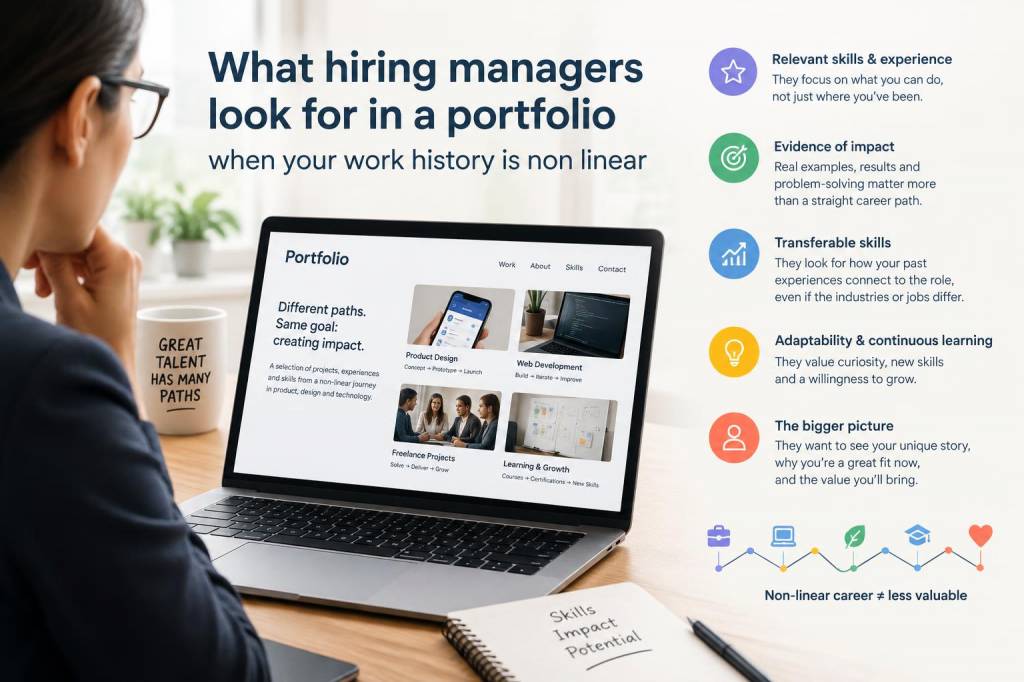
When I review a portfolio for someone with a non-linear work history, I am not looking for a neat ladder. I am looking for proof of direction, judgement, and transferability. A portfolio can do something a CV often cannot: it can show how different roles, breaks, side projects, freelance work, volunteering, study, and career changes still connect into a credible professional story.
That matters because many capable people do not move in a straight line. I have seen portfolios from parents returning to work, career changers moving from hospitality into tech, graduates who built experience through short contracts, and professionals who took a detour into self-employment before re-entering employment. In those cases, hiring managers are rarely asking, “Why is this messy?” They are asking, “Can I trust this person to do the work, learn fast, and add value?”
What I want to explain here is what I believe hiring managers actually notice first, what makes them lose confidence, and what gives them enough reassurance to keep reading. When your background does not follow a single clean path, your portfolio needs to work harder than a simple list of job titles. It needs to connect the dots for me.
What I look for before I even open a project sample
Before I dive into examples, I scan for structure. A portfolio with a non-linear history should feel intentional, not improvised. I want to see a clear opening summary that tells me who you are now, what kind of role you want, and what strengths have followed you through different stages of your career.
That summary does not need to be long. In fact, I usually prefer something direct. If someone has worked in retail, events, customer service, and content creation, I want a short statement that says they are now aiming for a client-facing marketing role and bring audience awareness, communication skill, and fast turnaround under pressure. That kind of framing gives me a lens for everything that follows.
I also look for signs of order. Portfolios that are easy to navigate feel more trustworthy. If I need to guess where the strongest work is, I start to lose patience. If I can find case studies, writing samples, design work, data projects, or campaign summaries quickly, I am more likely to believe the person understands professional presentation.
I look for a story, not an apology
One of the most important things I notice is whether the portfolio sounds apologetic. Many candidates with a non-linear path over-explain gaps or try to defend every transition. I understand why they do it, but it often weakens the portfolio. A hiring manager does not need a long apology. I need clarity.
I respond much better when someone frames their path as a series of deliberate steps. If they changed sectors, I want to see what they learned from each move. If they took time away from work, I want to see whether they used that time to build skills, care for family, study, volunteer, or create work samples. If they tried freelancing, I want to see evidence of client management, deadlines, and outcomes, even if the business was small.
The strongest portfolios I see do not pretend every step was planned from day one. They simply show that each step contributed something useful. That is much more believable, and it helps me imagine how that person would fit into my team.
Skills matter more when job titles do not tell the full story
When work history is non-linear, job titles can be misleading. A candidate may have held several short roles, but those roles may have built a strong mix of skills. A portfolio is where those skills become visible.
I want to see evidence of abilities that transfer across industries, such as:
- Clear written communication
- Problem solving under pressure
- Stakeholder or client management
- Project coordination
- Data handling and reporting
- Creative thinking and initiative
- Digital tools and systems confidence
It helps when each sample is annotated. I do not just want to admire a finished piece; I want to know what your role was, what challenge you faced, what tools you used, and what changed because of your work. A short caption can do a lot of heavy lifting. For example, if you redesigned a volunteer newsletter, tell me what the goal was, how you approached the task, and what improved after launch.
That is especially useful if your history includes roles that do not seem related at first glance. A former teacher, for instance, may have strong presentation, planning, and feedback skills that are directly relevant to training, content, or HR. A former warehouse coordinator may have impressive process discipline and accuracy that matter in operations or administration. I notice those connections when candidates make them visible.
Evidence beats claims every time
I am far more persuaded by evidence than by broad claims. If a portfolio says someone is detail-oriented, I want to see work that proves it. If it says someone improved engagement, I want to see numbers, screenshots, before-and-after comparisons, testimonials, or measurable outcomes.
This is where many portfolios fall short. They include attractive pieces but very little context. As a hiring manager, I need to understand impact. Even in creative fields, I am asking practical questions: Did this piece solve a problem? Did it save time? Did it attract users? Did it increase clarity, quality, sales, or response rates?
For non-linear candidates, evidence is especially powerful because it reduces doubt. If your background is varied, proof gives your story weight. A single strong case study can do more than a polished list of employers. I want to know what changed because you were involved.
When possible, I like to see a mix of evidence types:
- Live project links
- Short written case studies
- Metrics or outcomes
- Client feedback or references
- Before-and-after examples
- Process notes or reflections
What makes me trust a portfolio from someone with gaps or detours
Trust comes from coherence. I am not expecting a perfect timeline. I am expecting a reasonable explanation for how one stage led to another. If there were gaps, I want them handled with confidence rather than avoidance.
For example, if someone worked part-time while studying and then took freelance work, I can easily follow that. If they changed sector after burnout, I appreciate honesty and a clear explanation of what they are looking for now. If they spent time caring for a family member, I respect that far more when they present it plainly and then show what they have done to stay current.
What I do not trust is confusion. If the portfolio jumps from one interest to another without any framing, I have to work too hard to understand the candidate. If the work samples do not match the role being sought, I may assume they have not focused their search enough.
That is why I value a clear “through-line.” It may be customer focus, analytical thinking, visual communication, process improvement, or relationship building. Whatever it is, I want to see it repeated in different forms across the portfolio.
How I judge career changes inside a portfolio
Career changes are not a problem if the portfolio shows transfer and intent. In fact, many hiring managers enjoy a strong career change story because it can signal resilience and commitment. What matters is whether the candidate has done enough to bridge the gap between old experience and new goals.
If someone is moving into UX from marketing, I would expect to see some combination of user research, wireframes, appraisals of digital journeys, or relevant coursework. If someone is moving into project management from administration, I would want evidence of scheduling, coordination, risk awareness, and multi-tasking across stakeholders. If someone is entering finance from operations, I would look for numerical accuracy, reporting, and process discipline.
I become more confident when the portfolio shows deliberate preparation. That might mean:
- Self-directed projects
- Certificates or short courses
- Volunteer work in a relevant setting
- Freelance assignments
- Personal projects that mirror real tasks
It is not about pretending you have already done the job for years. It is about showing enough overlap that I can picture you succeeding with support.
What usually weakens a portfolio in my eyes
There are a few patterns that reduce confidence quickly. The first is over-design with under-substance. A portfolio can look impressive and still fail if the work itself is thin or poorly explained. I would rather see fewer pieces with strong context than a flashy collection with no substance.
The second is inconsistency. If the visual style, tone, and formatting change wildly from page to page, I start to wonder whether the person pays attention to detail. A non-linear history does not need a chaotic portfolio.
The third is irrelevance. I understand that people want to show range, but I still need focus. If every sample points to a different career aim, I cannot easily tell where the person wants to go. That is especially important for applicants who are trying to move into a specific field.
The fourth is silence. If the portfolio shows the final outcome but not the thinking behind it, I lose part of the value. I often make hiring decisions based not just on output, but on how someone works. A portfolio should reveal process, not just results.
What I wish more candidates included
If I could ask every non-linear candidate to add a few things, I would ask for a short profile statement, brief project notes, and a skills map. A skills map is simply a clear way to show what you do well and where that skill has appeared across different roles.
I would also like to see a section that explains “selected experience” rather than “all experience.” That helps candidates choose the most relevant evidence instead of feeling forced to include everything. A portfolio does not need to capture every job ever held. It needs to support the role you want now.
Another useful element is a short reflection on learning. If you changed direction, I want to know what you learned from the move. If you took on freelance or volunteer work, I want to know what it taught you about responsibility, communication, or confidence. Reflection shows maturity, and maturity matters.
| Portfolio element | What I notice | Why it matters |
|---|---|---|
| Opening summary | Career focus and current direction | Helps me understand the narrative quickly |
| Project notes | Context, role, challenge, outcome | Shows thinking and contribution |
| Evidence of impact | Metrics, feedback, results | Builds trust and credibility |
| Skills map | Transferable strengths across roles | Connects varied experience to one target role |
| Learning examples | Courses, projects, volunteer work | Shows momentum and commitment |
What I remember after reviewing a strong portfolio
After I finish reviewing a strong portfolio, I do not remember whether the person followed a perfect route. I remember whether they made sense. I remember whether their work showed judgement, usefulness, and intention. I remember whether they knew how to present their experience in a way that made my decision easier.
That is really what hiring managers want from a portfolio when work history is non-linear: clarity, proof, and a reason to believe the next chapter is already taking shape. If your background includes turns, pauses, side paths, or reinventions, your portfolio should not hide them. It should organise them into a story that feels credible, practical, and ready for work.