I have reviewed a lot of CVs for part-time roles, and I keep seeing the same problem: people make their experience look thinner than it really is. They either shorten everything so much that their strengths disappear, or they pad the page with irrelevant detail and hope quantity will compensate for structure. It usually does not. A strong part-time CV does not need to look packed with full-time history. It needs to look intentional, relevant, and reliable.
When I write or review a CV for a part-time application, I start from a simple idea: part-time employers are not looking for a perfect career story, they are looking for proof that I can turn up, learn quickly, work with others, and do the job well within the hours available. That means a part-time CV should show value without pretending a short work history is something else. If I have studied, cared for family, volunteered, worked shifts, or changed sectors, all of that can support the application if I present it properly.
Start with a profile that explains your fit
The opening profile matters more than many people realise. If I am applying for a part-time job, I want the reader to understand within a few seconds why I am suitable and what kind of working pattern I need. A short profile can solve a lot of problems before they begin, especially if my background is patchy, changing, or mixed with study and other commitments.
I keep this section focused on three things: what I do, what I bring, and what I am looking for. That might sound simple, but it creates shape. For example, instead of saying, “I am seeking a role where I can gain experience,” I would write something closer to, “Reliable and customer-focused candidate with experience in retail, administration, and team-based service roles, seeking a part-time position where strong communication and organisation can add immediate value.” That tells a clearer story and prevents my CV from looking empty.
If I have limited paid experience, I do not apologise for it in the profile. I focus on transferable skills instead. Confidence matters here. A part-time employer usually wants reassurance, not excuses.
Use a structure that makes short experience look purposeful
One reason a CV can feel incomplete is poor structure. If I only list jobs in reverse order and leave out everything else, the document may look sparse even when I have plenty to offer. I prefer a structure that gives space to relevant strengths, not just job titles.
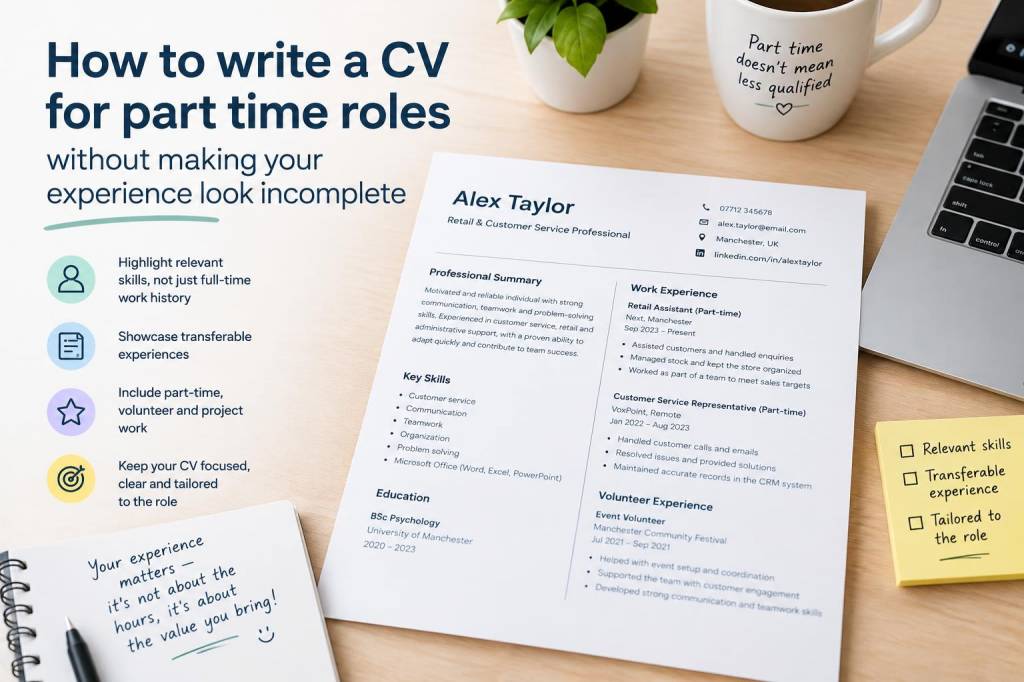
A practical structure for part-time roles often includes:
- Profile summary with role fit and availability
- Key skills linked to the target job
- Work experience with achievements, not only duties
- Education if it supports the application
- Volunteering, projects, or extracurricular experience if relevant
- Additional information such as software, languages, or shift availability
This structure helps because it lets me expand the parts of my background that matter most. If I have only one or two jobs, I can balance that with skills, volunteering, and specific achievements. The CV no longer looks incomplete; it looks organised.
Turn every role into evidence
I often tell people that a CV is not a list of places I have been. It is a list of proof. Even if a role was short, informal, or part-time, I can still show impact. The mistake many candidates make is writing duties only. Duties alone can make a CV feel flat and unfinished. Results make it feel credible.
For example, instead of writing, “Worked in a cafe serving customers,” I could write, “Served customers during busy lunch periods, handled cash and card payments accurately, and supported a smooth handover between front-of-house and kitchen teams.” That is much stronger because it shows pace, accuracy, and teamwork.
If I worked in a shop, office, warehouse, school, or hospitality setting, I can always find something measurable or specific: number of customers served, systems used, tasks completed, rota flexibility, error reduction, or praise from supervisors. Even if I do not have exact figures, I can still show scale and responsibility with plain language.
| Weak entry | Stronger entry |
| Helped with admin tasks | Managed filing, updated spreadsheets, and processed incoming emails for a small office team |
| Worked in retail | Supported customers, restocked shelves, and maintained a tidy shop floor during peak trading hours |
| Volunteered at events | Welcomed visitors, answered questions, and coordinated registrations at community events |
That small shift changes everything. It makes my experience look active and useful rather than unfinished.
Include skills that match part-time hiring reality
Part-time employers usually care about a specific mix of skills: reliability, timekeeping, communication, flexibility, customer service, teamwork, and basic digital confidence. If I include a skills section, I should not fill it with vague words like “hardworking” and “motivated” alone. Those words are fine, but they need support.
I prefer to write skills that connect to real situations. For example:
- Customer service: Dealt with enquiries politely and efficiently in fast-paced settings
- Organisation: Managed competing tasks while meeting deadlines and rota changes
- Communication: Worked closely with colleagues, customers, and supervisors to keep work moving
- Digital skills: Used Outlook, Excel, POS systems, or scheduling tools confidently
- Adaptability: Adjusted quickly to changing priorities and short notice requests
That kind of wording gives substance. It also helps if my employment history is short, because the skills section shows that I understand what part-time employers need from day one.
Do not hide gaps; explain them cleanly
Gaps do not automatically damage a CV. Unclear gaps do. I have seen many candidates make their experience look incomplete by trying to disguise breaks in employment instead of handling them directly. A short explanation can be far more effective than silence.
If I spent time studying, caring for someone, recovering from illness, raising children, travelling, or looking after personal commitments, I can explain that in a simple and professional way. I do not need a long story. I just need enough context so the reader understands the timeline.
For example, I might include a line such as, “Career break for family responsibilities,” or “Full-time study alongside occasional freelance work.” If I used that time to build skills, I can include those too. Maybe I completed a course, volunteered locally, or developed digital confidence. That turns a gap into part of the story rather than a problem left hanging.
What I avoid is overexplaining. Employers do not need every private detail. They need clarity, honesty, and evidence that I am ready for work now.
Make part-time availability work in my favour
Some candidates hide their availability because they fear it will limit them. In reality, clear availability often helps. If I am applying for a part-time role, I should make it easy for an employer to see when I can work. If my availability is restricted to school hours, evenings, weekends, or set days, I can say so briefly in the CV or cover note.
This is especially useful in retail, hospitality, care, office support, and customer service roles where rota planning matters. I have seen applications improve simply because the employer did not need to guess whether the candidate could cover the required shifts.
If I have flexibility, I should mention it. If I have limits, I should be honest but positive. Something like “Available for weekday afternoons and weekends” is much better than leaving the employer uncertain.
Use education and training strategically
Education can be a strong part of a part-time CV, especially for students, recent graduates, and career changers. But it needs to be presented with purpose. I do not need to list every module unless it supports the role. Instead, I can emphasise relevant subjects, coursework, practical projects, or training that demonstrates useful skills.
If I studied business, health, computing, media, or childcare, I can connect that learning to the job. If I completed first aid, safeguarding, food hygiene, customer service, or Microsoft training, that is worth including too. Even short online courses can help when they show commitment and relevance.
I also like to mention projects when they demonstrate initiative. A group presentation, research project, student society role, fundraising event, or freelance task can all support a part-time application if they reveal organisation, teamwork, or problem-solving.
Adapt wording to each role without rewriting everything
A CV for part-time work should still be tailored. I do not need to start from zero each time, but I do need to adjust the language so it mirrors the role I want. If I am applying for a part-time sales assistant position, I should emphasise service, stock handling, and communication. If I am applying for an admin job, I should emphasise organisation, accuracy, and software use.
I also pay attention to the employer’s wording. If they mention “reliable,” “customer-facing,” “team player,” or “fast-paced environment,” I should reflect those needs naturally in my CV, as long as I can support them with evidence. This is not about stuffing in keywords. It is about showing that I understand what matters in that workplace.
When I tailor a CV properly, even a short employment history looks sharper. It becomes obvious that I am a deliberate match rather than a generic applicant.
A simple layout can make a smaller background look stronger
Design matters more than many people think. If my CV is cramped, cluttered, or inconsistent, it can make even strong experience look weak. For part-time roles, I prefer a clean layout with clear headings, enough spacing, and concise bullet points. That way, the reader can scan quickly and still see the value in my experience.
I avoid overcrowding the page with long paragraphs. I also avoid shrinking the font or squeezing in unrelated detail just to fill space. A focused one-page CV can be far more effective than a messy two-page version. If I genuinely have enough relevant experience for two pages, that is fine, but I should never force length for its own sake.
What matters most is balance. My CV should show enough detail to build confidence without making the reader search for the point.
If I want my part-time CV to feel complete, I focus on what employers actually need to see: relevant experience, transferable skills, clear structure, honest context, and proof that I can add value from the first week. That approach does not inflate my background, but it does make it stronger, clearer, and easier to trust.