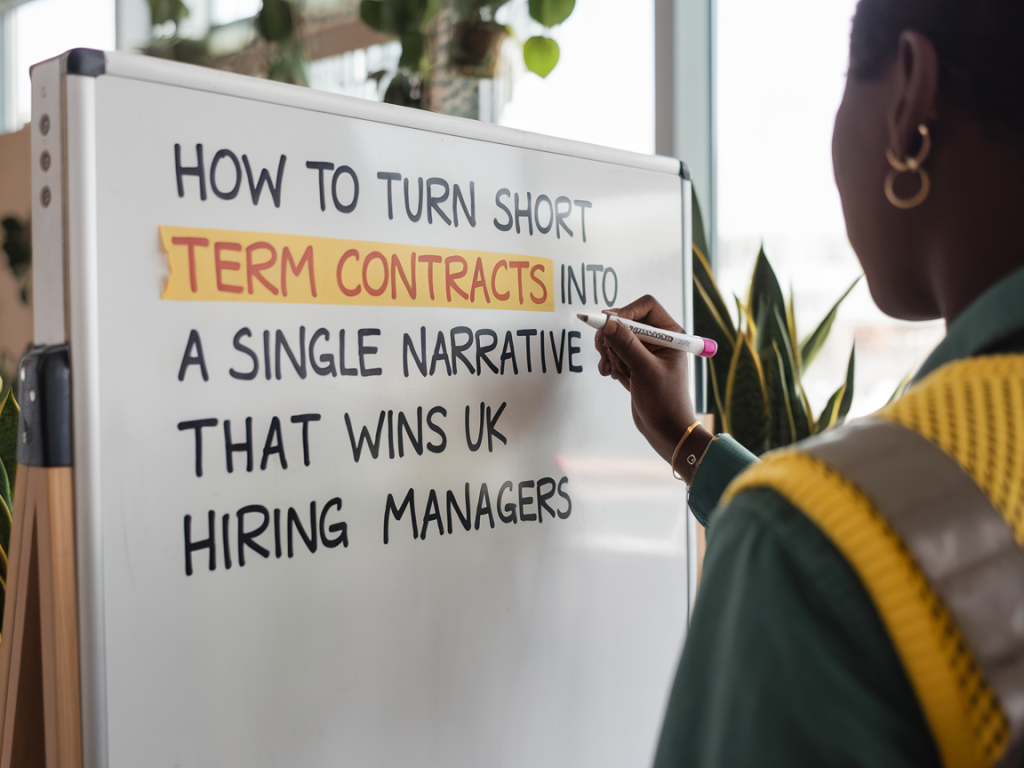
Short-term contracts can feel like a puzzle when you’re trying to present a coherent career story. I’ve worked with hundreds of candidates in the UK who worried that a CV full of 3–6 month roles looked unstable or unfocused. The good news? Short contracts don’t have to read as scattergun experience. With a few structural choices and the right language, you can turn them into a single, persuasive narrative that hiring managers recognise and value.
Start with a clear through-line
When I review CVs, the first thing I look for is a through-line — a theme that connects roles across employers. That might be a technical expertise (e.g. "data analysis"), a sector focus (e.g. "public health projects"), or a functional skill (e.g. "project delivery"). If you’ve done several short contracts, pick the thread that best matches the roles you want next and make it explicit in your personal profile or summary.
Example sentence to use in your summary: “Delivery-focused project manager with 3+ years of short-term contracts supporting NHS transformation and digital rollout projects.” That single line turns apparently disparate gigs into a consistent offering.
Group similar contracts together
Rather than listing every contract separately, you can create grouped entries on your CV. This improves readability and emphasises continuity.
Two common approaches I recommend:
Grouping reduces visual fragmentation and lets you control the narrative: you’re a specialist who has applied their skillset in multiple contexts, not a job-hopper.
Frame short durations positively
Short contracts often have acceptable, even desirable reasons behind them: fixed-term funding, maternity cover, secondments, or portfolio careers. Use your CV and cover letter to explain — briefly and confidently — why the roles were short.
This shows hiring managers that the duration was structural, not performance-based.
Lead with outcomes, not dates
Hiring managers care about what you delivered more than how long you were in post. For each contract, prioritise achievements, metrics and the impact you had.
Use LinkedIn and portfolio pages to expand
Your CV is a snapshot; LinkedIn and a simple portfolio website let you expand without cluttering the document. I encourage candidates to:
Link to these from your CV: “Selected case studies: www.yourname.co.uk/case-studies”. Hiring managers who want more will click; others get the concise CV they need.
Prepare a short, confident interview script
Interviewers will ask about short stints. Prepare a 30–60 second answer that explains the role purpose, what you achieved and how it prepared you for the role you’re applying for. Keep it factual:
Practice it until it sounds natural but not rehearsed.
Make ATS-friendly choices
Applicant Tracking Systems (ATS) can misread non-standard formats. For grouped contracts, keep headings simple and keyword-rich.
| Good | Example |
| Heading | Contract Project Manager (Various clients) |
| Keywords | project management, stakeholder engagement, Agile, Jira, digital transformation |
| Formatting | Plain fonts, clear dates, bullet points |
Including the year range and clear job titles improves parsing. Avoid images, excessive tables, or unusual symbols that break ATS parsing.
Leverage references and testimonials
Short contracts can be validated by strong references. If a client or hiring manager praised your performance, ask for a short LinkedIn recommendation or a written testimonial you can paste into a portfolio page. A single sentence from a credible source (e.g. “Delivered our CRM project on time and under budget — Head of Sales, Company X”) carries weight.
Tailor applications — highlight the most relevant contracts
For each application, reorder your grouped bullets to emphasise the projects that best match the job spec. If the role asks for stakeholder management and you had a 3-month contract coordinating cross-functional teams, lead with that example even if it wasn’t your longest engagement.
When to keep separate listings
Not every contract should be grouped. If a short role represented a significant promotion, unique skill (e.g. AWS migration), or a named employer that adds credibility (e.g. GSK, BBC), list it separately with full details. Use judgement: group for continuity, separate for signal.
In my experience, hiring managers respond to clarity. Short-term contracts are an asset when presented as deliberate experience-building, outcome-driven work. Pick a through-line, group where it makes sense, lead with impact, and use LinkedIn and a portfolio to host the fuller story. Do that, and your CV will read less like a list of stop-starts and more like a targeted career path that matches the role you want.