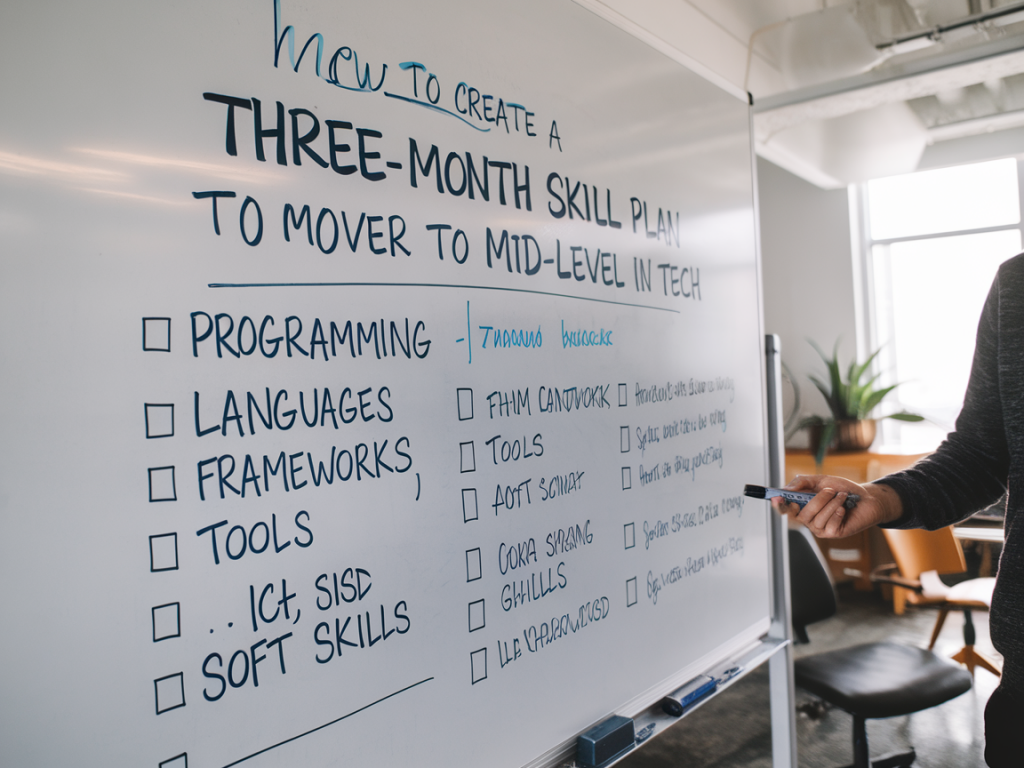
I remember the moment I realised "junior" no longer fit the way I wanted to work: I could ship features, but I hesitated when designing systems; I solved bugs, but I rarely owned product decisions. If that sounds familiar, a focused three‑month plan can bridge the gap. Below I share a practical, evidence‑based roadmap I use with clients to move from junior to mid‑level in tech — balanced across technical competence, ownership and communication.
What being "mid‑level" actually means
First, a quick reality check. Mid‑level isn't just about years on a CV. In hiring and on teams it usually means you can:
- Deliver features end‑to‑end with limited guidance;
- Diagnose and fix non‑trivial problems and reason about trade‑offs;
- Collaborate confidently across product, design and QA;
- Communicate your decisions to peers and stakeholders.
If you can make steady progress on these four areas, you'll start to be seen and treated like a mid‑level engineer.
The three‑month structure I recommend
I break three months into three focused blocks. Each month has a primary theme and complementary weekly habits:
- Month 1 — Foundations: close technical gaps, improve code quality and testing.
- Month 2 — Ownership: own a small feature or subsystem and drive it to production.
- Month 3 — Communication & Influence: improve design trade‑offs, architecture thinking and cross‑team collaboration.
Weekly habits to practice throughout
These are daily/weekly habits I ask clients to keep active alongside their monthly theme:
- Spend 30–60 minutes on deliberate practice: LeetCode medium problems (for algorithmic thinking) or language‑specific kata.
- Read one technical article or RFC a week (I use Engineering blogs, arXiv, or company tech blogs).
- Pair programming or code review twice a week — aim to both give and receive feedback.
- Update a learning log: one paragraph per day about what you tried, what worked and what confused you.
Concrete month‑by‑month plan
Below is the playbook I give clients. Treat it as a template you adjust for your stack and team context.
| Month | Objectives | Weekly focus | Deliverable |
|---|---|---|---|
| Month 1 — Foundations | Improve code quality, testing and core language skills |
| PR with improved tests, refactor and updated docs |
| Month 2 — Ownership | Deliver a feature from spec to production |
| Deployed feature + post‑release notes and metrics |
| Month 3 — Communication & Influence | Make better trade‑offs, mentor others, and present solutions |
| Design doc, mentoring log, presentation slides |
Tools and resources I recommend
Pick tools that fit your workflow. Here are ones I find useful:
- Code & testing: Jest, pytest, RSpec or your stack's standard test runner. Use GitHub Actions for CI if your team doesn't already.
- Learning platforms: Coursera, Udemy, Pluralsight for structured courses; Frontend Masters or Egghead for hands‑on front‑end skills.
- Problem solving: LeetCode and HackerRank for algorithm practice; Exercism for language fluency.
- Architecture & design docs: C4 Model diagrams (Structurizr) and simple Google Docs templates for decisions.
- Tracking progress: Notion or Trello for your plan, and a simple GitHub repo for "learning PRs" or small demos.
How to choose the right feature to own
Ownership is where perception changes fastest — but choose wisely. Look for a piece of work that is:
- Small enough to ship in 2–3 weeks but non‑trivial;
- Cross‑functional so you practice communication with product and QA;
- Valuable — has a measurable user or business impact;
- Visible — the outcome will be seen by stakeholders.
Pitch a short spec: problem, user impact, proposed solution, risks and a rollback plan. This demonstrates judgement and reduces risk for your team — both signs of mid‑level thinking.
How I measure progress each week
I ask clients to answer three quick questions every Sunday evening:
- What did I deliver this week?
- What blocked me and how will I remove it?
- One skill I practised and one insight I learned.
Keep the answers brief. Over three months this creates an evidence trail you can show in performance reviews or interviews.
Common pitfalls and how I help clients avoid them
I've seen the same blockers repeatedly:
- Trying to learn everything: Narrow scope. Depth beats breadth in three months.
- Focusing only on algorithms: Those matter, but delivering features and communicating matter more for levelling up.
- Being passive: Ask for feedback, volunteer for ownership and request a mentor session.
- No visibility: Share progress in standups, write a short weekly update on Slack or your team wiki.
Examples of small wins you can aim for
- Reduce a flaky integration test and add a stable end‑to‑end test.
- Ship a feature that reduces a manual step for the support team and measure time saved.
- Lead a two‑hour design session and produce a clear decision log.
- Mentor a junior through a bug fix and document the debugging steps.
If you follow a structured plan like this and keep the weekly habits consistent, three months is enough to change how colleagues perceive you. You won't magically become a staff engineer — and you shouldn't expect to — but you'll shift into the mindset and behaviours that define mid‑level engineers: independent delivery, clearer trade‑offs, and growing influence.
When you're ready, create your personalised version of this plan, share it with your manager, and ask for specific opportunities to own a piece of work. If you want a template for the spec, a one‑page learning log, or a review of your proposed feature, I can share examples I use with clients.